
Agentic AI Orchestration:
What If Your Business Could Give You Back Your Life?
You started your business to build a better future for yourself and your family. But somewhere along the way, did your business begin taking more of your life than you intended?
In This Article:
- Your typical day...
- Imagine having a team of digital assistants working for you
- What's the difference between an AI Agent and Agentic AI?
- Can AI really save you time? What does the research say?
- Which parts of your business could you start delegating to AI?
- Which AI tools should you try first?
- How do you get started? The XCITECH six-step approach
- What if you could recover just one hour every working day?
- Your business should support your life, not consume it
- Let Xcitech help you take the first step
Your typical day...
Does this sound like your typical day?
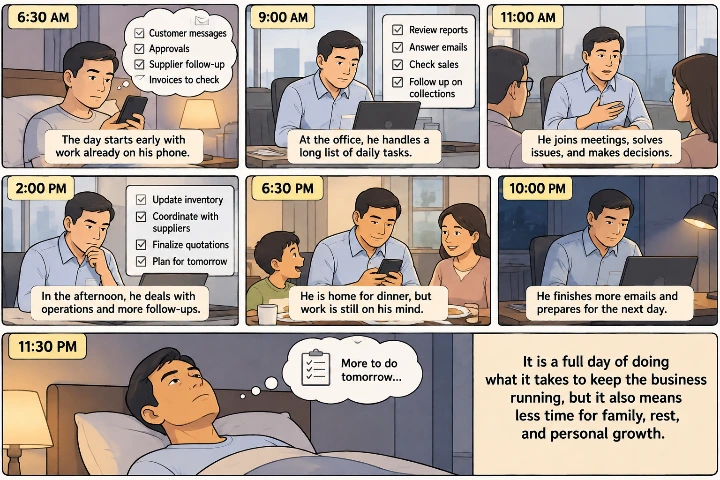
You wake up in the morning and, before you even get out of bed, you're already checking your phone.
There are customer messages waiting for replies. An employee needs your approval. A supplier is following up on payment. Someone from accounting needs to clarify an invoice. And you haven't even had your morning coffee.
By the time you arrive at the office, your day is already filled with things that need your attention.
You attend meetings, answer questions, review reports, solve employee problems, and make decisions. You intended to spend some time planning your company's growth, but something urgent always comes up.
Before you know it, it's evening.
You go home, hoping to spend quality time with your family. But your phone keeps buzzing. There are emails to answer, customer concerns to resolve, and tomorrow's activities to prepare. You're physically home, but your mind is still at work.
Perhaps your spouse has become accustomed to seeing you distracted during dinner. Your children have learned not to interrupt when you're on the phone. Your weekends are no longer entirely your own.
And what about yourself?
When was the last time you had enough time to read a good book, learn something new, exercise regularly, or simply enjoy a quiet afternoon?
If you're a person of faith, perhaps you've also noticed how difficult it has become to set aside meaningful time for prayer, reflection, fellowship, or serving others. You may be doing reasonably well financially. Your business might even be growing. But are you enjoying the life you worked so hard to build?
Here's a question worth asking: Are you running your business, or has your business started running your life?
If any of this sounds familiar, you're certainly not alone.
And there's a technology development worth exploring that might help you change the situation. It's called Agentic Artificial Intelligence, or Agentic AI.
Don't worry about the technical terminology. What matters is what it can potentially do for you, your employees, and your business.
BACK TO TOP OF PAGE
Imagine having a team of digital assistants working for you
What's the difference between an AI Agent and Agentic AI?
That's a good starting point.
But most of these interactions require you to initiate the request, provide information, and decide what to do with the response.
An AI Agent takes this further. Think of an AI Agent as a digital employee assigned to accomplish a particular task or objective.
For example, you could have a Sales Follow-up Agent that checks your customer database, identifies prospects who haven't received a reply, prepares follow-up messages, and asks your salesperson to approve them.
An Accounting Agent could monitor outstanding invoices and prepare collection reminders. A Customer Service Agent could answer common inquiries and refer complicated concerns to your staff.
Agentic AI is the broader technology that enables AI systems to plan steps, use business applications, make limited decisions, and carry out tasks toward a defined goal.
And Agentic AI Orchestration is what happens when you coordinate these agents, the applications they use, and the people supervising them so that they work together.
Here's a simple example.
A customer places an order through your website. Your Sales Agent records the order. Your Inventory Agent checks product availability. Your Fulfillment Agent prepares a delivery request. Your Accounting Agent prepares the invoice. Your Customer Service Agent sends the customer an update.
All these activities can be coordinated through one workflow, with appropriate human approvals. You don't need to personally oversee every handoff. You remain in charge, but you no longer have to be involved in every small activity.
That's a very important distinction.
AI should help you become a better business leader, not turn your business into something you no longer understand or control.
Can AI really save you time? What does the research say?
We've all heard promises about technology making work easier, only to discover that we now have more applications to manage and more notifications to answer.
Fortunately, there is growing research from institutions such as Harvard and Stanford showing that AI can genuinely improve productivity when applied to appropriate tasks.
Researchers from Harvard Business School and collaborating institutions studied 758 consultants working on professional assignments. Those using GPT-4 completed suitable tasks about 25% faster and produced higher-quality results than their counterparts without AI assistance.
In another study involving 5,172 customer-support workers, researchers including Stanford economist Erik Brynjolfsson found that AI assistance increased the number of customer issues resolved per hour by approximately 15%, on average.
A workplace experiment involving 7,137 employees, conducted by researchers affiliated with Harvard and Microsoft, also found that frequent users of AI tools spent approximately 3.6 fewer hours per week on email. That was a finding for frequent users, not the average effect across all employees.
These are meaningful improvements.
But there's something else you should understand.
These studies primarily examined AI assistance, not fully autonomous agents running entire businesses. So we shouldn't assume that installing a few AI tools will automatically produce the same results in your company.
In fact, Harvard research involving 640 entrepreneurs in Kenya found that AI advice produced uneven outcomes. Some entrepreneurs benefited, while others experienced worse business results.
The lesson? AI is powerful, but it isn't magic.
It works best when you know what problem you're trying to solve, have reliable business information, and establish clear rules about what the technology can and cannot do.
That's why I would encourage you to start small and build confidence through actual results.
Which parts of your business could you start delegating to AI?
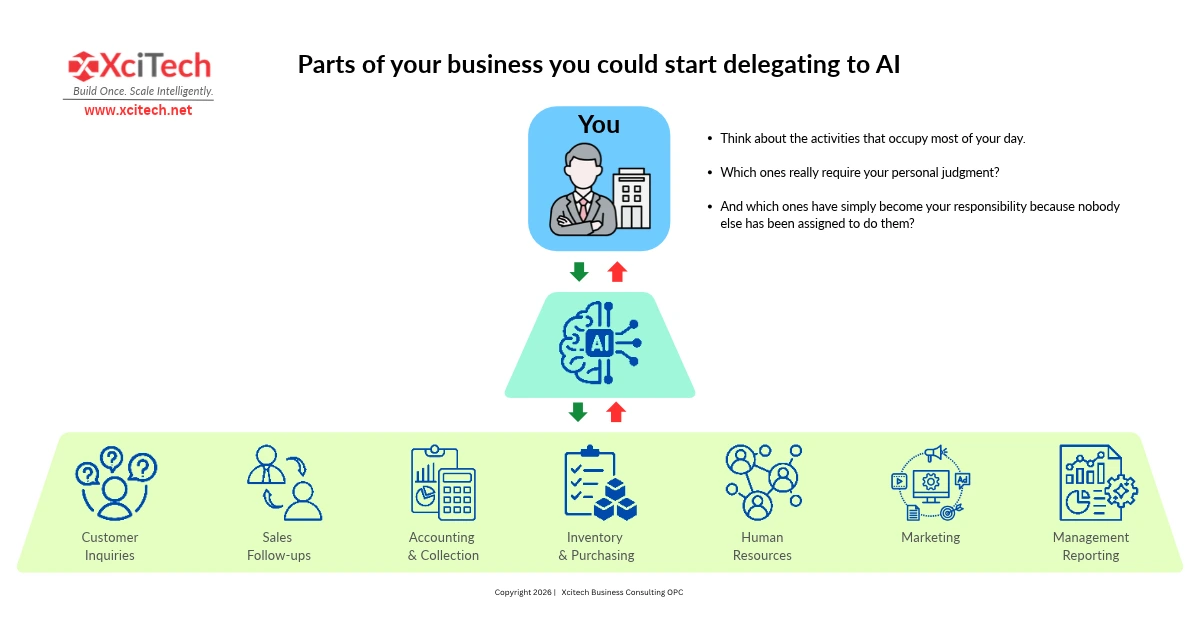
1. Customer inquiries: Stop answering the same questions repeatedly
How often do customers ask about your operating hours, prices, product availability, delivery schedules, or payment options?
If your staff spends hours answering the same questions, an AI assistant could handle many of them using information you've approved.
Your employees can then concentrate on customers who need personal attention. And you won't have to keep checking your business messages late into the evening.
2. Sales follow-ups: Don't let opportunities slip through the cracks
Have you ever discovered that a potential customer never received a follow-up after requesting a quotation? It happens more often than many business owners realize.
An AI agent connected to your sales system can monitor pending quotations, prepare reminders, and alert your team when a prospect needs attention.
Instead of chasing your salespeople for updates, you can concentrate on important customer relationships and closing significant deals.
3. Accounting and collections: Know where your money stands
Cash flow is one of the biggest sources of stress for SME owners. You need to know who owes you money, which payments are due, and whether you have enough cash for upcoming obligations.
An AI-assisted system can prepare daily cash summaries, identify overdue accounts, flag unusual expenses, and draft collection reminders.
You should still retain control over payment approvals, bank-account changes, and important financial decisions. But you shouldn't have to spend an hour every day manually assembling information that your accounting system already contains.
4. Inventory and purchasing: Reduce the surprises
If you operate a retail, distribution, or manufacturing business, you know how frustrating it can be to discover that a popular product is out of stock.
An AI agent can monitor stock levels, identify products that need replenishment, and prepare purchasing recommendations. It can also highlight slow-moving inventory that ties up your working capital.
Imagine receiving an early warning instead of discovering the problem after a customer complains.
5. Human resources: Give your managers more time for people
Your HR team probably spends considerable time answering routine questions, organizing interviews, checking attendance, and preparing employee documents.
AI can help with many of these administrative tasks. But decisions involving hiring, promotion, discipline, and employee welfare should remain with responsible people. After all, your employees aren't just numbers in a database.
The goal is to give your managers more time to coach, mentor, and develop their teams.
6. Marketing: Stay visible without spending every evening creating content
You know your business needs consistent marketing. But who has the time to prepare social media posts, newsletters, promotional materials, and customer announcements?
AI can help develop content calendars, prepare drafts, suggest campaigns, and organize communications. You still decide what represents your business and what messages should be published. Instead of staring at a blank screen every evening, you can spend a few minutes reviewing well-prepared material.
7. Management reporting: Get the information you need without chasing everyone
This may be one of the most valuable applications for a busy business owner. Imagine receiving one daily management briefing covering sales, collections, inventory, customer concerns, and pending approvals.
You don't need to open several spreadsheets or call multiple employees just to find out what's happening. You can concentrate on the exceptions, the opportunities, and the decisions that genuinely need you.
That's the kind of business visibility that can make leadership less stressful.
Which AI tools should you try first?
Several tools are already available, and some may even be included in software you're currently using.
Here's a simple guide.
AI Tool | How It Can Help You | Where To Use It Best |
ChatGPT | Write emails, analyze information, prepare reports, brainstorm ideas, and create assistants | Planning, marketing, management |
Microsoft 365 Copilot | Work with emails, spreadsheets, documents, and meeting summaries | Office administration and reporting |
Google Gemini | Assist with Gmail, Docs, Sheets, and other supported Google tools (like Project) | Communications and daily productivity |
Zapier | Connect different applications and automate repetitive activities | Sales follow-ups and notifications |
Make | Build visual workflows connecting multiple business systems | Order processing and operations |
n8n | Create customized automations and AI-enabled workflows | Advanced business orchestration |
Odoo | Manage integrated business records and automate processes, with AI features (Version 19 and soon, 20). All-in-one business software. | Sales, accounting, inventory, purchasing |
HubSpot | Manage customer relationships and automate sales and marketing activities | Manage customer relationships and automate sales and marketing activities |
If you're already using Microsoft 365 or Google Workspace, explore the AI tools available in your subscription.
If you're using Odoo, you may have opportunities to automate activities using the information already stored in your ERP system.
And if you're using several unrelated applications, tools such as Zapier, Make, or n8n may help connect them.
My advice is simple: Don't buy technology because it's fashionable. Choose technology because it solves a problem that matters to you.
How do you get started? The XCITECH six-step approach
You don't have to transform your entire business overnight.
At Xcitech, we propose a practical six-step approach using the acronym XCITECH.
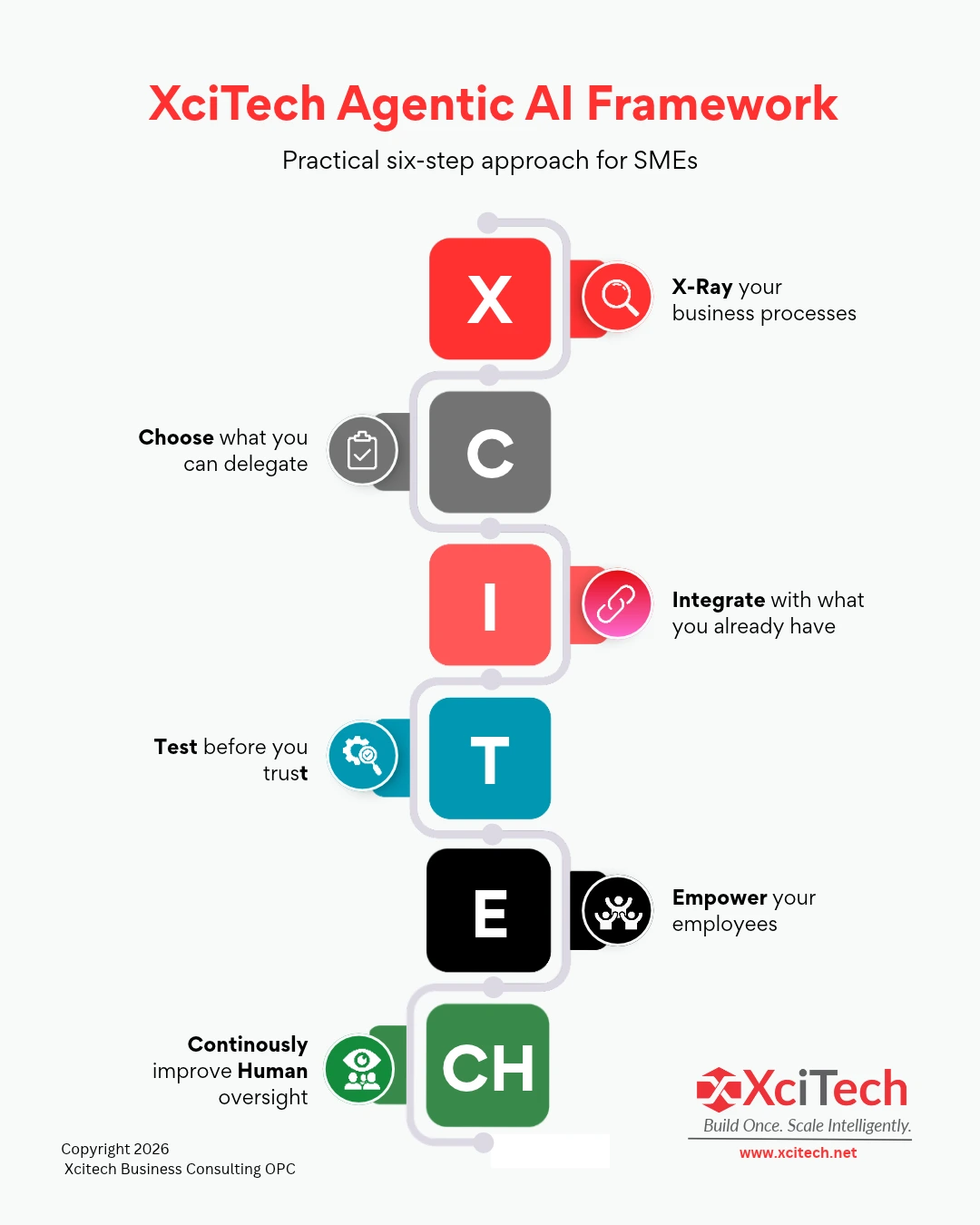
X-ray your business processes
- Start by examining how you spend your working day.
For one week, take note of the activities that consume your time.
- How much time do you spend checking reports?
- Answering emails?
- Following up on employees?
- Reviewing invoices?
- Resolving routine problems?
- Identify the three activities that create the most frustration or take the most time.
- You may be surprised by what you discover.
Choose what you can delegate
- Look at your list and ask yourself which tasks genuinely require your personal attention.
- Start with repetitive activities that follow clear rules and carry relatively low risks.
- You might begin with daily sales reporting, customer inquiry handling, or collection reminders.
- Don't attempt to automate important financial or personnel decisions immediately.
- Choose one workflow and get it right.
Integrate with what you already have
Before buying new software, look at the applications your business is already using.
Are your customer records in a spreadsheet?
- Are you using an accounting application?
- Do you have an ERP system such as Odoo?
- Your AI agent will need access to the right information to do useful work.
- The objective is to connect your existing systems wherever practical, not replace everything unnecessarily.
- Of course, protect your customer and employee information. Give AI tools only the access they need.
Test before you trust
- Don't immediately allow an AI agent to operate independently.
- Let it work alongside your employees first.
- Compare its output with actual results. Check whether it makes mistakes, saves time, and produces reliable information.
- For activities involving customers, payments, or important business records, require human approval until appropriate safeguards and performance standards are established.
- Trust should be earned through consistent results.
Empower your employees
This is important. Your employees may worry that introducing AI means you're planning to replace them.
- Explain that your immediate objective is to reduce repetitive work and help them become more productive.
- Teach them how to use AI responsibly, review its outputs, and handle situations that require human judgment.
- Encourage them to develop new skills.
- You don't want a company full of employees who simply follow whatever AI tells them.
- You want people who become better at their jobs because they know how to use technology intelligently.
Continuously improve with Human oversight
Once your first AI agent is working reliably, review its performance.
- How many hours has it saved?
- Have errors decreased?
- Are customers receiving faster responses?
- Are your employees less burdened by routine work?
- Most importantly, has it actually reduced the amount of time you personally spend managing daily operations?
- Continue improving the workflow and consider expanding to other areas.
- Keep people accountable for important decisions.
Remember, you're not trying to build a business controlled by AI. You're building a business where AI helps you and your people perform better.
What if you could recover just one hour every working day?
Suppose you currently spend 90 minutes every morning gathering reports, checking updates, and following up on routine matters. With a properly implemented AI-assisted workflow, imagine reducing that to 30 minutes.
That's one hour recovered every working day.
Five hours per week. Approximately 22 hours per month. Around 260 hours per year, assuming five working days per week and 52 weeks per year.
These are illustrative savings, not guaranteed results.
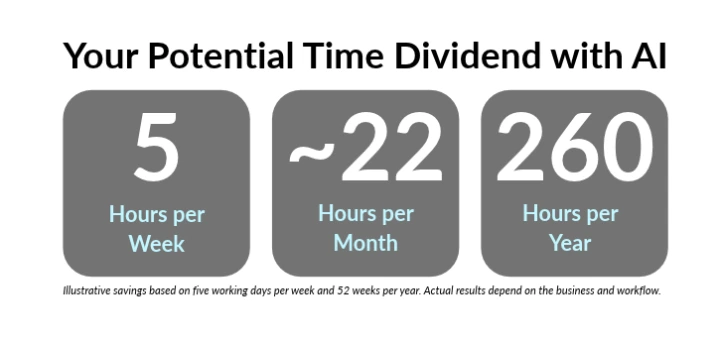
Now think about what you could do with those 260 hours.
- You could spend more evenings having meaningful conversations with your spouse and children.
- You could exercise regularly, get enough sleep, or pursue a hobby you've been postponing.
- You could read more books, attend a course, or develop skills that help you become a better leader.
- You could devote more time to your spiritual life, participate in ministry, volunteer in your community, or simply have quiet moments for prayer and reflection.
- Or you could spend some of those hours thinking about the future of your business instead of constantly reacting to its daily problems.
Of course, recovering that time requires more than installing AI. You must also make a conscious decision not to fill every newly available hour with more work.
Because the real benefit isn't simply that you can accomplish more. It's that you can choose what to do with the time you've recovered.
Your business should support your life, not consume it
When you started your business, what were your dreams?
Perhaps you wanted financial security for your family. Maybe you wanted to send your children to good schools, build a comfortable home, or create something you could eventually pass on to the next generation. Perhaps you also wanted the freedom to travel, pursue your interests, support your church, or contribute to your community.
Those are meaningful aspirations.
But somewhere along the way, the demands of running the business may have taken precedence over the reasons you started it.
Technology cannot solve every problem. AI cannot replace good leadership, meaningful relationships, wise judgment, or personal discipline.
But it can help remove some of the routine burdens that prevent you from focusing on those things. And that is why I believe Agentic AI deserves serious consideration by SME owners. Not because it is the latest technology trend. Not because everyone else seems to be talking about it.
But because, when implemented responsibly, it can help you build a more efficient business without requiring you to sacrifice so much of your personal life.
Let Xcitech help you take the first step
At Xcitech Business Consulting OPC, we understand that running an SME is already complicated enough.
The last thing you need is another technology project that consumes your time, confuses your employees, or adds unnecessary expenses. That's why we believe your Agentic AI journey should begin with a conversation about your business, not a sales presentation about software.
Let's look at the activities that occupy your day. Let's identify the tasks that can be safely automated. Let's explore the tools that fit your existing systems and your budget. You don't need to automate everything. You don't even need to start with several AI agents.
Sometimes, one well-designed workflow that saves you an hour every day is already a meaningful achievement. And as your confidence grows, we can help you explore more opportunities to make your business work smarter.
Our goal is to help you build a business that is more productive, more manageable, and less dependent on your constant personal involvement. Because we believe your success should be measured not only by how much your business earns, but also by the quality of life it allows you and your family to enjoy.
"You started your business to build a better life, not to spend your entire life running it. Let AI take care of more of the routine, so you can give more of your time to your family, your faith, your personal growth, and the things that make life truly meaningful."
If you're ready to explore what Agentic AI can do for your business, we'd be glad to help you get started.
Visit www.xcitech.net and let's talk about how to make your business work better for you.
After all, your business is an important part of your life. But it should never become your entire life.
1. Dell'Acqua, F., et al. (2023). Navigating the Jagged Technological Frontier: Field Experimental Evidence of the Effects of AI on Knowledge Worker Productivity and Quality. Harvard Business School Working Paper 24-013. https://www.hbs.edu/faculty/Pages/item.aspx?num=64700
2. Brynjolfsson, E., Li, D., and Raymond, L. (2025). Generative AI at Work. The Quarterly Journal of Economics, 140(2), 889-942. https://www.gsb.stanford.edu/faculty-research/publications/generative-ai-work
3. Dillon, E. W., Jaffe, S., Immorlica, N., and Stanton, C. T. (2025). Shifting Work Patterns with Generative AI. Harvard Business School and Microsoft Research, NBER Working Paper 33795. https://www.nber.org/papers/w33795
4. Otis, N. G., Clarke, R., Delecourt, S., Holtz, D., and Koning, R. (2023). The Uneven Impact of Generative AI on Entrepreneurial Performance. Research on AI assistance among Kenyan entrepreneurs.
5. Stanford Institute for Human-Centered Artificial Intelligence (2026). AI Index Report 2026. https://hai.stanford.edu/ai-index